
World Models
Model how environments change over time and in response to actions.
Current stage: research direction. See related repositories for implementation and tests.
RESEARCH
A research path from observation to action
A world model asks what might happen after an action. We study representations, action-conditioned prediction, future rollout, planning and evaluation. The sequence below describes a research direction, not a claim that every component is mature.
RESEARCH PHILOSOPHY
Given current observations and a possible action, it tries to anticipate how the environment might change. These predictions can help a system compare futures before acting.
RESEARCH DIRECTION · Research path illustration
A research map, not a claim that every component is validated or deployable on a physical robot.
FOCUS AREAS
Model how environments change over time and in response to actions.
Current stage: research direction. See related repositories for implementation and tests.
Extract states from observations that support prediction and action.
Current stage: research direction. See related repositories for implementation and tests.
Study how possible outcomes depend on the chosen action.
Current stage: research direction. See related repositories for implementation and tests.
Build useful representations of position, structure and relationships.
Current stage: research direction. See related repositories for implementation and tests.
Distinguish co-occurrence, change and consequences while keeping claims testable.
Current stage: research direction. See related repositories for implementation and tests.
Explore how predictions can inform goal-directed action selection.
Current stage: research direction. See related repositories for implementation and tests.
In a fixed PushT comparison, pose-objective planning achieved 66% success (33/50), versus 22% (11/50) for the coverage-objective control: +44 percentage points. Both use the same predictor, sensors and per-decision budget. This result is limited to this simulation task. Additional results cover a development-bank JEPA task-readout comparison with extra physical priors, contact-task adaptation on V-JEPA representations, and latent/position prediction improvements. See all results for their specific conditions.
Selected results ↗02 / COMPARISONS
Six separate experiments. Each figure keeps its task, baseline and conditions; open a figure or its execution record.
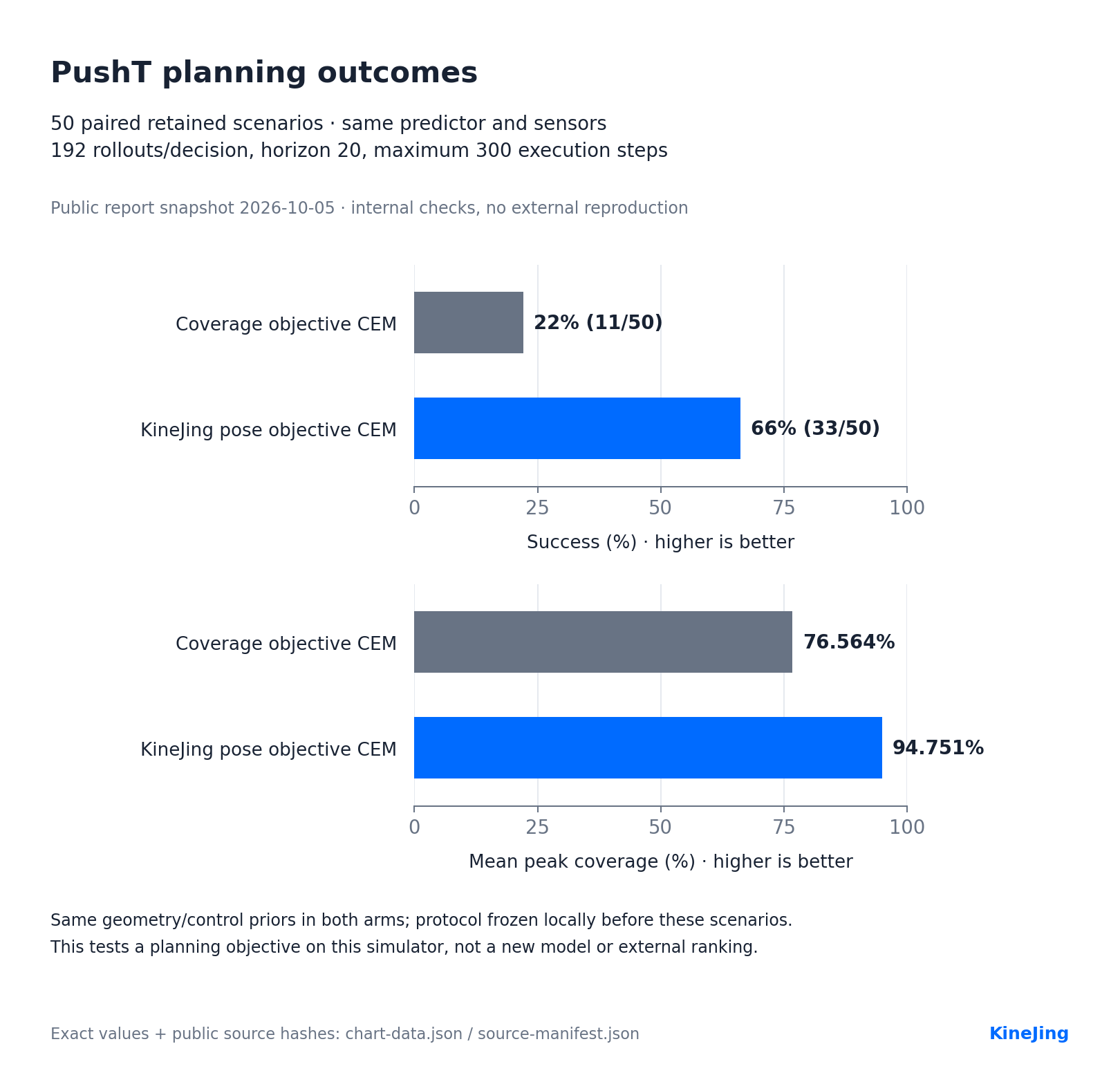
01 / PushT · 50 paired scenarios
Pose objective 33/50; coverage objective 11/50. Matched predictor, sensors and per-decision budget; this simulation protocol only.
Execution record ↗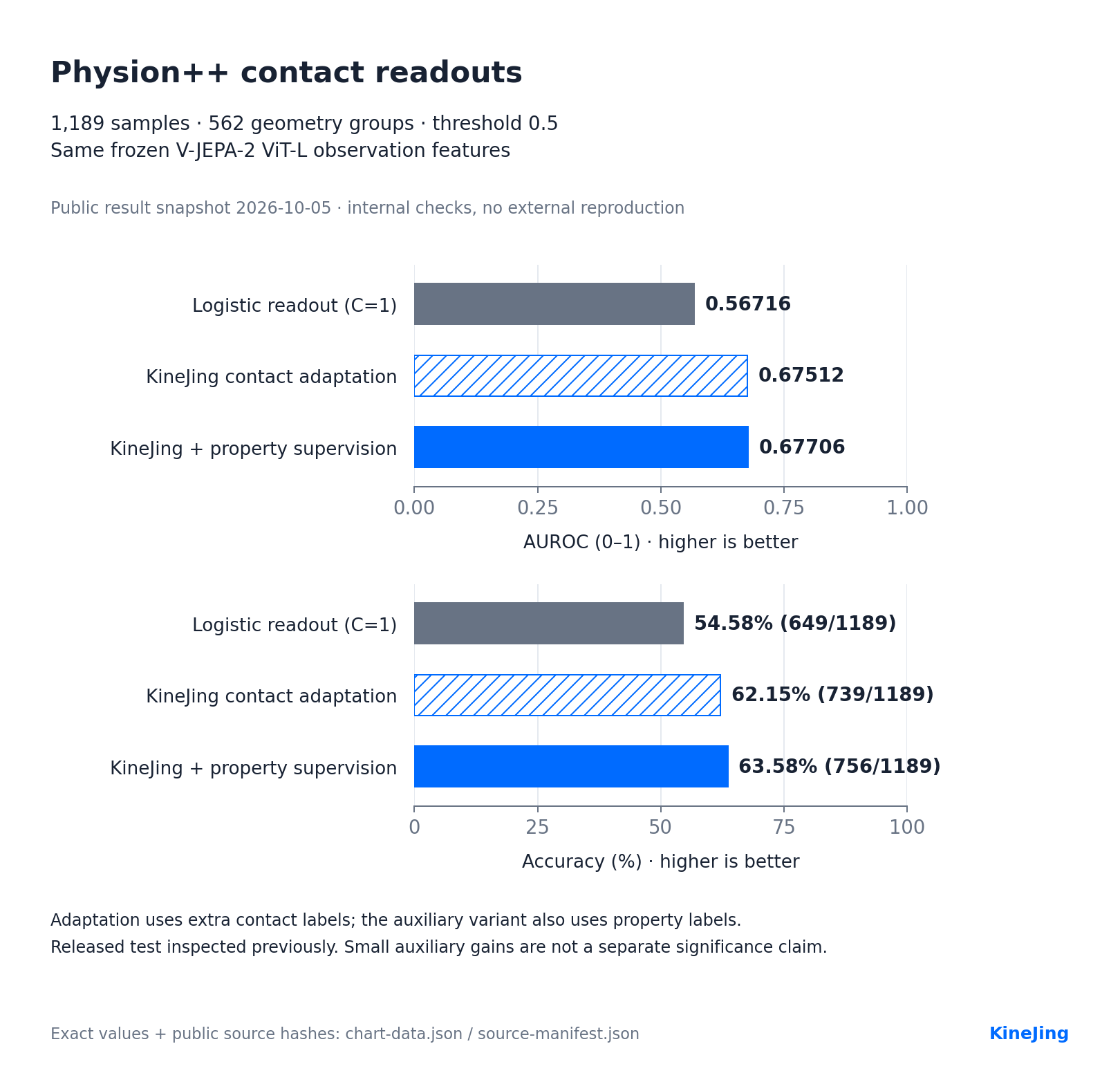
02 / Physion++ · Frozen-feature readouts
1,189 samples, frozen V-JEPA-2 features, with added task and property supervision. The test was previously inspected: re-evaluation, not a new blind test.
Execution record ↗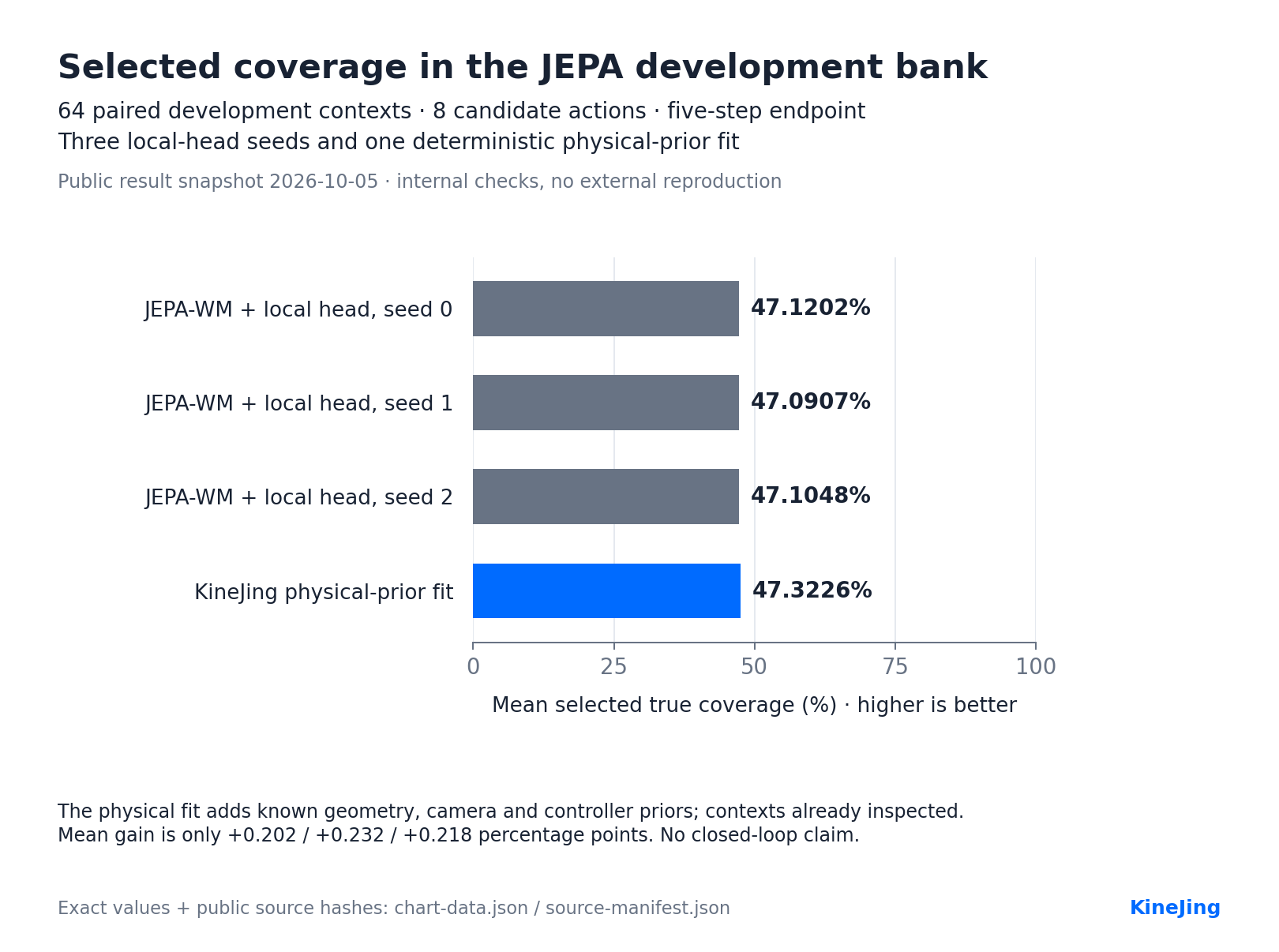
03 / JEPA · Development contexts
64 development contexts, including three local JEPA-head seeds and physical-prior configurations; not an independent blind test.
Execution record ↗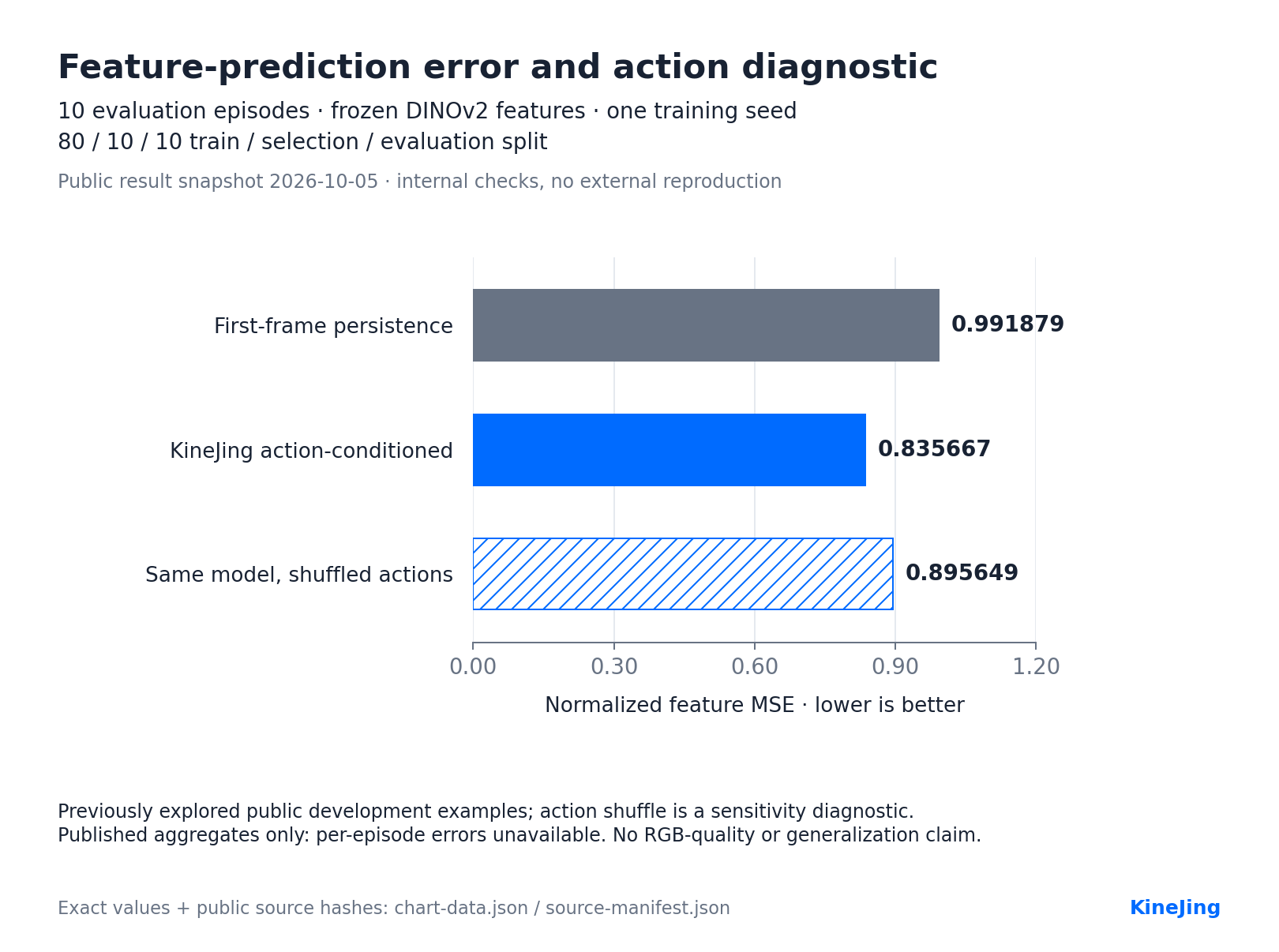
04 / Feature prediction · Action diagnostic
Normalized MSE on frozen DINOv2 features, with persistence and shuffled-action controls; a feature-level diagnostic.
Execution record ↗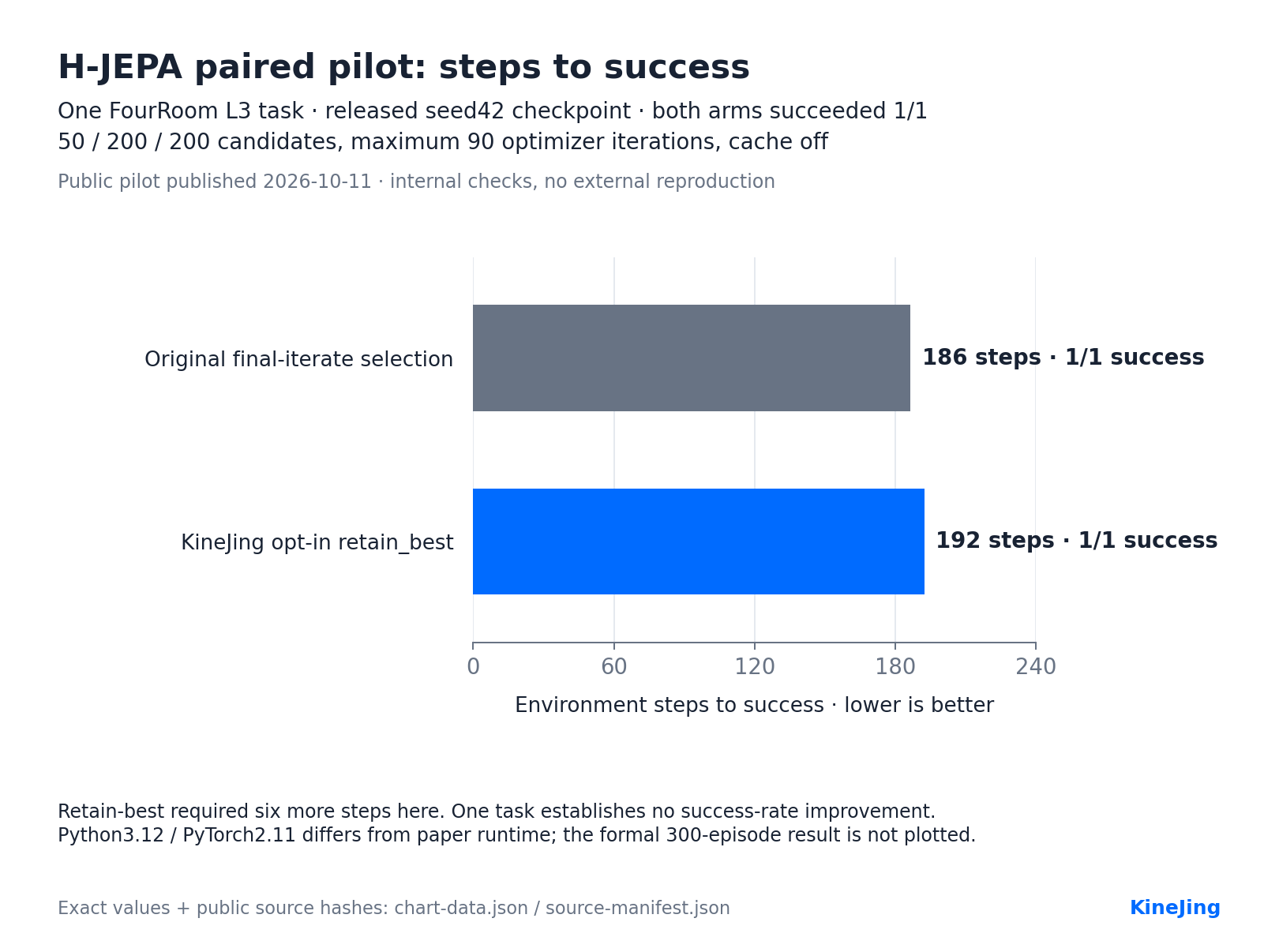
05 / H-JEPA · One matched pilot
Same released L3 weights: baseline 186 steps; retain-best 192; both succeed 1/1. This pilot does not show a success-rate gain.
Execution record ↗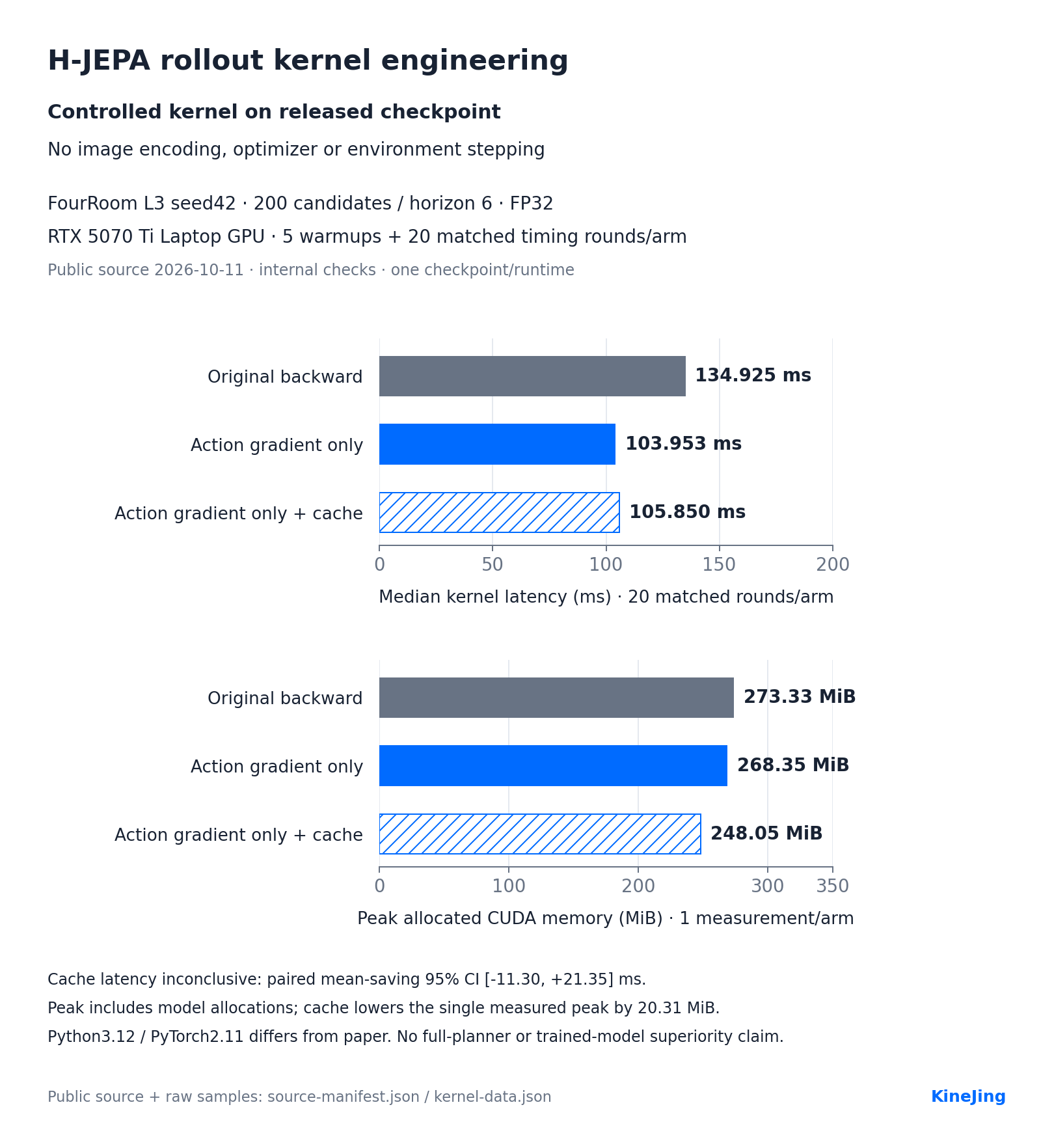
06 / H-JEPA · Controlled L3 kernel
Gradient and cache configurations under a controlled kernel protocol. Kernel timing does not replace end-to-end planning or robot evaluation.
Execution record ↗